
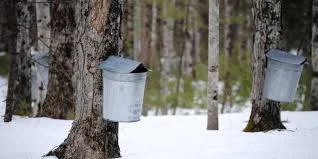
Spring in Vermont has a notoriously uneven start. None of the old adages about lions and lambs, showers and flowers are a part of the spring algorithm. What is a sure sign of spring, however, is the sudden appearance of sap buckets along the dirt roads, or the Ford 150s loaded with food-grade sap storage barrels or cubes, put by the roadside or on the edge of the hedgerows where blue tubing drains the sap into them. For sap to run, the days get a little longer and the light softer. Temperatures vary wildly, but in an ideal sap world, it’s below freezing at night and above during the day.
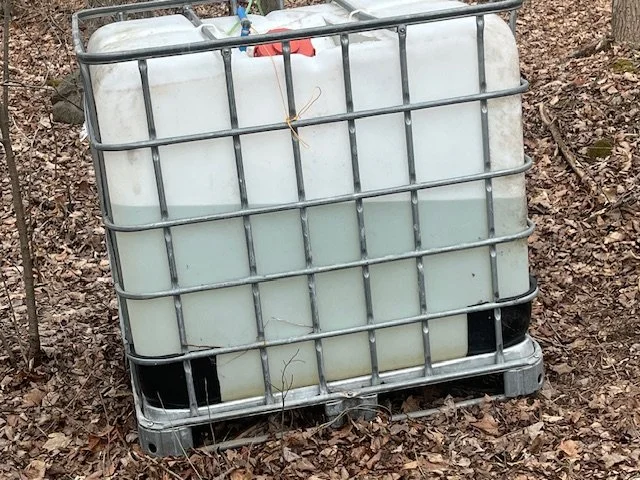
The trees wake up as the sap rises. Even this process is unpredictable and dependent on the amount of snow during the winter, how deep the ground has frozen, the strength of the sunlight, the trees’ location (open pasture or in a forest), age of the tree, and variety. The variables for sap-production are endless but the constant is the alchemy of making syrup, reliant on the improbable relation of sugar content to finished syrup. In our case, it’s about 45 gallons of sap to a gallon of syrup.
Huge commercial syrup makers use thousands of taps and pricey reverse osmosis rigs to suck the sap out of a tree and then reduce the water content at a blistering pace. Vermont is a big producer of maple syrup in the US, producing upwards of 3.1 million gallons of syrup (representing a 100 million dollar crop). It is big business. Some call it a religion.
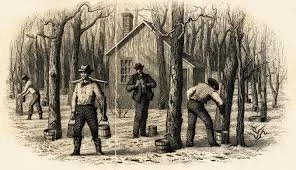
Not all sugar bushes (i.e. maple syrup producers) are the same. There are big ones, and then there are backyard community groups that make maple syrup for fun. Sap Moon Sugar Works, here in Weybridge, Vermont, is one of the fun ones.
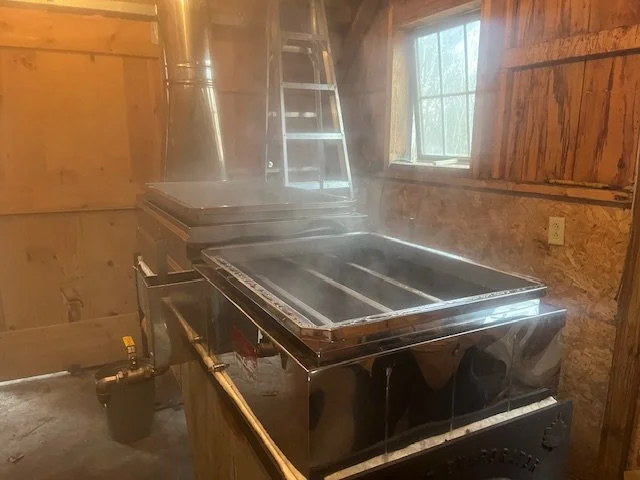
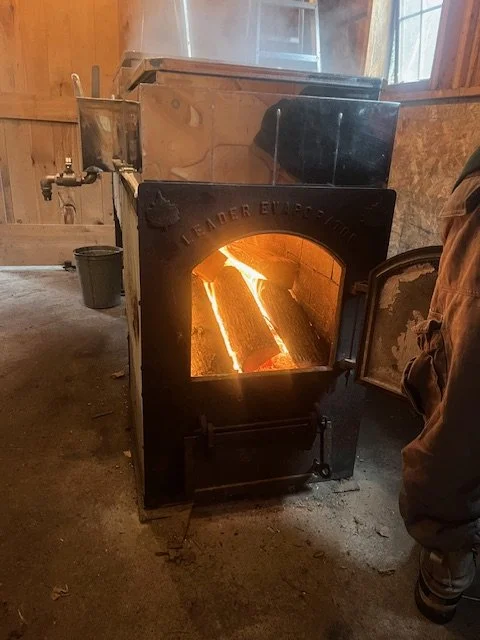
My late husband and I built our sugar house with the help of old friends on the rise behind our home at the edge of a deep old-growth hemlock forest. A small shed houses the Arch and Syrup evaporator, a beautiful, efficient backyard rig made by the Leader Evaporator Company in Vermont’s North East Kingdom. The Arch has an insulated fire box that accommodates 18 inch logs or bigger, and an evaporator that sits on top made up of stainless steel pans, sensitive to heat fluctuations and easily warped, where the sap turns into syrup.
We hang buckets on President's Day weekend, a holiday that’s easy to remember, a possible date when the weather will change and the sap will run. Our group is eclectic. We come from all different walks of life and include newcomers to Vermont and our neighborhood as well as those who’ve been around awhile. None of us are professional syrup makers. Our ranks include retirees as well as those still working. The goal is to pull people together making syrup and let the trees and the process take it from there.
We do have a few rules. No money changes hands and you can’t sell the syrup. You can donate it to raise money for groups, give it away, and include it in gift bags, but it is not commercial. Our syrup has been tucked into luggage and left as a unique gift from New Zealand to the Pamirs. We map all the places our syrup lands. Sap Moon Sugar Works has circumnavigated the globe, a sweet ambassador of spring in Vermont.
Many people ask, Can we buy the syrup? and the answer is always no, but we will give you some. This financial arrangement extends throughout the process. Different people buy the wood each year, or provide containers, or help with repairs. It’s a real collective. Our little group has even expanded to another town; the Vergennes gang caught the syrup fever from us.
The process itself requires a commitment that’s not always apparent until you do it. Buckets need to be gathered and emptied, each one holding three gallons of sap that eventually goes in a 50-gallon barrel in the back of my truck. This year we had 200 taps in several locations and collected 2,033 gallons of sap, amounting to 40 gallons of syrup.
Once we have about 250 gallons of sap, we start a boil. The rig gets fired up around seven in the morning and we go from there. The sugar house has to be manned all day as the process requires concentration and vigilance. Sap can boil over in a flash to coat the rig and the floor with sticky half-done caramelized syrup. Cleaning it up is a nightmare. I speak from experience.
Wood has to be constantly shoved in the fire box as the syrup is coaxed from the back of the rig to the finishing pans in the front. The temperature under the pans has to remain constant to ensure an even boil. There’s a real art to being able to almost-finish the syrup in the pan.
The draw is next: the syrup is filtered through a thick felt filter, then transferred to the kitchen. The crew there filters it again to get it ready to bottle. Finishing syrup means bringing it back up to a specific temperature and skimming off the goop that rises to the top. The skimmed bi-product is a very strong syrup that we affectionately refer to as Pond Scum, coveted by many as it makes unbelievable pound cake.
Another bi-product is what happens when we come together. Many of us don’t know each other very well; we only assemble as a group during syrup season, once a year. The process is time-consuming, so we have time to talk between draws, as the sap boils, as the light fades and the sugar house lights come on. We eat together. Sometimes all together around my dining room table, which was my grandfather’s and can accommodate 16 if we need it, which we often do. Other times we eat in shifts as the boil requires a midnight watch. Our food is also the product of the community as everyone brings something to add.
The conversations are as varied as the participants. Politics, religion, farming, theatre, books, health, or simply the state of things all swirl around the steam and the pond scum. It is one of the few ways that strangers converge with a common sweet goal and time is spent listening. Arguments are rarely posed and never won. It reminds me of a really good seminar except that this one lasts for as long as the trees let us.
Then, as fast as it started, syrup season is over. The true sign is the peepers in the creek. They are the harbinger of the end. The sap goes milky and we race to finish off what we have before it spoils, then pull the buckets to wash and stow. The rig cools down, the stack comes down, and the work of cleaning starts. In short order everything is done—the work of many hands. We divvy up the syrup among all of us, share one last gathering of food and conversation, and then disband until next year.
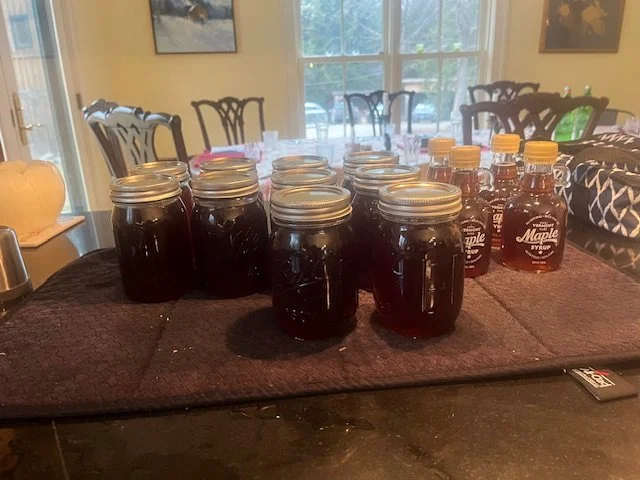
As the jars and cans of syrup accumulate, we marvel at how ridiculous but delightful this whole enterprise is. We’re enthralled by the sense of stillness and appreciation for each other found in the company of trees.
-Bird Jones